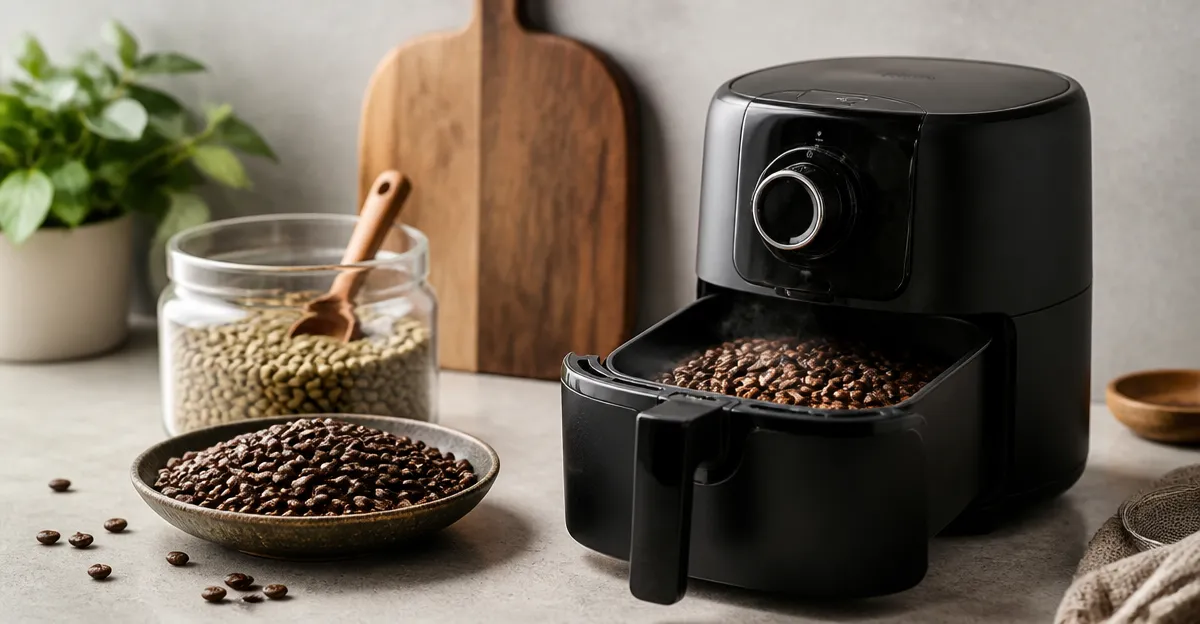
How to Roast Coffee Beans in a Mini Air Fryer: Easy Step‑by‑Step Small‑Batch Guide
Introduction
Roasting coffee beans at home empowers one to control flavor, aroma, and freshness. This guide explains how to achieve a consistent roast using a mini air fryer, a device that many households already own. The reader will learn the essential steps, safety considerations, and troubleshooting techniques required for small‑batch roasting. By the end of the article, one will be able to produce café‑quality beans without investing in expensive commercial equipment.
The process described relies on heat circulation, timing, and sensory observation rather than specialized roasters. Mini air fryers provide rapid, even heating and a confined space that mimics the environment of a traditional drum roaster. The guide remains valuable even for readers who prefer to use a conventional oven, but the air fryer method offers speed and energy efficiency.
What You'll Need
The following materials ensure a safe and successful roast. All items are readily available, and the recommended air fryers are listed with their Amazon links for convenience.
- Green (unroasted) coffee beans – preferably a single origin for flavor consistency.
- Mini air fryer – either the COMFEE Air Fryer or the Instant Pot Vortex Mini Air Fryer.
- Heat‑proof silicone mat or parchment paper – to line the basket and simplify cleanup.
- Metal or glass cooling tray – for rapid cooling after the roast.
- Digital kitchen scale – to measure bean weight accurately.
- Timer or smartphone timer – to track roasting intervals.
- Stirring spoon or spatula – for occasional bean agitation.
Step 1: Prepare Green Coffee Beans
Begin by weighing the desired amount of green beans. For a mini air fryer, 50 to 100 grams provides a manageable batch that fits comfortably in the basket. Place the beans on a clean surface and inspect them for any foreign material such as stones or husk fragments. Removing impurities prevents uneven heating and protects the appliance.
It is advisable to let the beans acclimate to room temperature for fifteen minutes before roasting. This practice reduces thermal shock and promotes a uniform roast curve. One may also pre‑sort the beans using a small sieve to ensure size uniformity, which contributes to consistent color development.
Step 2: Preheat the Mini Air Fryer
Preheating establishes a stable temperature baseline, a critical factor for reproducible roasts. Set the air fryer to 200 °C (392 °F), a midpoint that accommodates light, medium, and dark roasts with minor timer adjustments. The COMFEE Air Fryer offers an adjustable temperature range of 180‑400 °F and a digital display that simplifies precise preheat settings.
For users who prefer the Instant Pot brand, the Instant Pot Vortex Mini Air Fryer provides EvenCrisp technology and a clear window that allows visual monitoring during preheat. Allow the appliance to run empty for three minutes; this short cycle stabilizes the internal fan and heating element.
Step 3: Load Beans and Set the Timer
After preheat, carefully spread the measured beans in a single layer on the silicone mat placed inside the basket. Avoid overfilling; excess beans can obstruct airflow and cause uneven roasting. Secure the basket and close the lid, then select the appropriate timer setting based on the desired roast level.
A light roast typically requires eight to nine minutes, a medium roast nine to eleven minutes, and a dark roast twelve to fourteen minutes. The COMFEE model includes a built‑in 60‑minute timer with audible alerts, while the Instant Pot Vortex features a digital timer that can be paused for manual stirring if desired. Record the start time on a separate sheet to facilitate later analysis.
Step 4: Monitor Roast Development
During roasting, the beans will emit a series of audible cues known as “cracks.” The first crack, occurring around 196 °C, signals the transition from green to light roast. The second crack, near 224 °C, indicates the onset of dark roast characteristics. The clear window on the Instant Pot Vortex allows visual confirmation without opening the door, preserving heat and preventing temperature drop.
If the appliance lacks a window, rely on auditory cues and occasional brief openings to sniff the aroma. A short opening of two seconds is sufficient to assess scent without significantly affecting the roast curve. For precision, one may pause the cycle at the first crack, stir the beans gently with a silicone spatula, and resume cooking to ensure even exposure.
Step 5: Cool and Store the Roasted Beans
Immediately after the timer signals completion, transfer the beans to a metal cooling tray. Spread them thinly and stir continuously for one to two minutes to halt the roasting process. Rapid cooling prevents overdevelopment and preserves the intended flavor profile.
Allow the beans to rest for at least twelve hours in a loosely covered container before grinding. This degassing period enables carbon dioxide to escape, resulting in a more balanced extraction. Store the cooled beans in an airtight container away from direct sunlight for up to two weeks.
Tips & Pro Tips
- Use a digital scale for each batch to track bean weight loss; a typical roast reduces weight by 15‑20 percent.
- Experiment with bean varieties to discover personal flavor preferences; African beans often yield bright acidity, while Latin American beans provide nutty undertones.
- For a smoky profile, extend the roast by 30 seconds beyond the second crack, but monitor closely to avoid bitterness.
- Clean the air fryer basket after each use; the COMFEE model features a dishwasher‑safe nonstick basket, simplifying maintenance.
- Consider using the Instant Pot Vortex's “Dehydrate” function to dry beans before roasting if moisture content is high.
Troubleshooting
- Beans are unevenly roasted: Reduce batch size and ensure a single‑layer arrangement to promote uniform airflow.
- Excessive smoke: Verify that the air fryer vent is not obstructed and that the basket is placed correctly. Clean any residual oil from previous uses.
- Burnt flavor: Shorten the timer or lower the temperature by 10 °C; burnt beans often result from exceeding the second crack.
- Insufficient crunch: Increase the final temperature by 5 °C and extend the roast by 30 seconds to develop a deeper caramelization.
Conclusion
This guide has demonstrated how to roast coffee beans in a mini air fryer using a systematic, step‑by‑step approach. By selecting the appropriate appliance, measuring beans accurately, and monitoring temperature and audible cues, one can achieve consistent roasts ranging from light to dark. The included tips and troubleshooting section equips the reader with the knowledge to refine techniques over time. Embrace the process, experiment with origins, and enjoy freshly roasted coffee that reflects personal taste.
Products Mentioned in This Guide
Frequently Asked Questions
Can I roast any variety of green coffee beans in a mini air fryer?
Yes, most green beans roast well, but lighter beans may need a shorter time while darker beans may require a lower temperature.
What temperature and time settings work best for a small‑batch roast?
Set the air fryer to 350°F (175°C) and roast for 8–12 minutes, adjusting based on bean color and aroma.
How do I know when the beans have reached the desired roast level?
Listen for the first crack (light roast) and the second crack (medium to dark) while watching the bean color turn from green to brown.
Do I need to shake or stir the beans during roasting?
Yes, pause the cycle every 2–3 minutes to shake the basket, ensuring even heat distribution.
Is it safe to use a mini air fryer for coffee roasting?
It is safe as long as you monitor the process, keep the basket uncovered for airflow, and avoid exceeding the appliance’s maximum temperature.