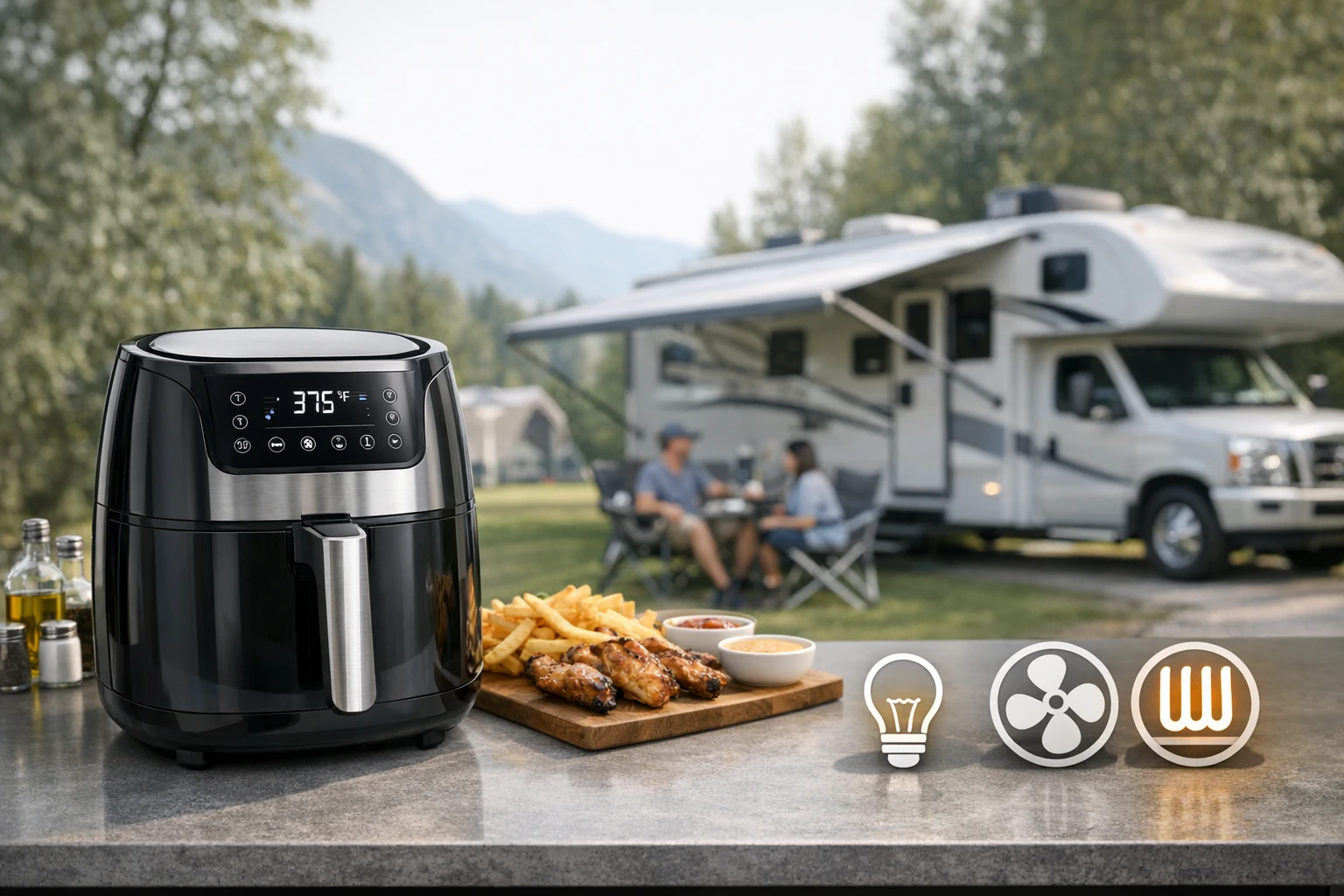
How to Choose the Right Wattage Air Fryer for Your RV: Safe Limits, Amps & Energy‑Saving Tips
Introduction
Recreational vehicle owners increasingly desire home‑cooked meals while on the road. This guide explains how to select an air fryer whose wattage aligns with a vehicle’s electrical system, how to calculate safe amperage, and which practical steps reduce power consumption. Readers will learn to avoid overloaded circuits, protect battery life, and enjoy healthier meals without compromising safety. The information is valuable for anyone who wishes to combine culinary convenience with the limited power budget of an RV.
What You’ll Need
- Access to the RV’s electrical specifications (circuit breaker rating, battery capacity, and inverter output).
- A portable power monitor or multimeter to verify real‑time draw.
- One of the recommended compact air fryers (see Step 3).
- Heavy‑duty, UL‑listed extension cord or power strip with built‑in surge protection.
Step 1: Assess Your RV’s Electrical Capacity
Begin by locating the main breaker panel and noting the amp rating of each 120‑volt branch circuit. Most Class C motorhomes provide 15‑amp or 20‑amp circuits for kitchen appliances; larger tow‑behind units may offer 30‑amp service. Record the maximum continuous load allowed on the circuit you intend to use, remembering that continuous loads should not exceed 80 % of the breaker rating. For a 15‑amp circuit, the safe continuous load is 12 amps (15 A × 0.8). This step ensures that the air fryer will not trip the breaker or drain the battery.
Next, consider whether you will operate the air fryer from shore power, a generator, or the vehicle’s inverter. Inverter capacity is often lower than shore power, typically ranging from 1,200 W to 2,000 W. Knowing the source helps you decide whether a lower‑wattage model is required. Finally, write down the available amperage for each power source; this information will be used in the next calculation.
Step 2: Calculate the Desired Wattage for Your Air Fryer
Air fryers vary widely in power consumption, usually between 800 W and 1,500 W. To determine whether a particular model fits your RV, use the formula: Watts = Volts × Amps. For a standard 120‑volt outlet, a 1,200‑watt fryer draws 10 amps (1,200 W ÷ 120 V = 10 A). Compare this figure with the safe continuous amperage from Step 1. If the required amperage exceeds the safe limit, select a lower‑wattage unit or plan to use a dedicated circuit.
It is also prudent to factor in other simultaneous loads, such as a refrigerator, microwave, or lighting. Subtract the estimated draw of these devices from the circuit’s safe amperage to obtain the remaining capacity for the air fryer. This margin prevents unexpected trips when multiple appliances operate together.
Step 3: Choose an Air Fryer That Matches Your Power Budget
Based on the calculations, select an air fryer whose wattage falls comfortably within the available amperage. The following products are well‑suited for RV use because of their compact size, modest power draw, and positive user feedback.
Dash Digital Tasti‑Crisp Air Fryer
The Dash Digital Tasti‑Crisp Air Fryer offers 2.6 qt capacity, digital temperature control, and an auto‑shut‑off feature that prevents overheating. It consumes approximately 1,200 W, drawing 10 A on a 120‑V circuit, which fits within a 15‑amp safe limit when no other high‑draw appliances share the circuit. At $49.99, it provides excellent value and holds a 4.5‑star rating from 7,785 reviewers, indicating reliable performance for small families or solo travelers.
COSORI Mini Air Fryer
The COSORI Mini Air Fryer uses 900 W, translating to 7.5 A on a 120‑V supply. Its 2.1‑qt basket is ideal for single‑serve meals, and the four‑function preset (air fry, roast, bake, reheat) adds versatility without increasing power demand. Priced at $59.99 and rated 4.6 stars by 8,181 reviewers, it balances efficiency with functionality, making it a strong candidate for RV kitchens with limited amperage.
Chefman Compact Air Fryer
The Chefman Compact Air Fryer delivers 1,500 W peak power, drawing 12.5 A. Although slightly higher than the previous models, its 4‑qt capacity can serve two to four people, and the Hi‑Fry technology provides extra crispness for larger meals. At $59.99 with a 4.6‑star rating from 3,762 reviewers, it is suitable for RV owners who have a dedicated 20‑amp circuit or who plan to use the fryer when other high‑draw devices are off.
Elite Gourmet Personal Air Fryer
The Elite Gourmet Personal Air Fryer consumes roughly 800 W (6.7 A), making it the most power‑conservative option. Its 1.1‑qt basket is perfect for individual portions, and the adjustable temperature dial ranges from 176 °F to 395 °F. Priced at $34.99 and earning a 4.3‑star rating from 272 reviewers, it is an excellent choice for travelers who prioritize minimal energy use.
When selecting a model, compare the wattage to the safe amperage calculated in Step 2. Choose the unit that provides the needed cooking capacity while staying comfortably below the circuit’s limit. This approach prevents breaker trips and preserves battery health.
Step 4: Install the Air Fryer Safely in Your RV
After choosing the appropriate air fryer, position it on a stable, heat‑resistant surface near a dedicated 120‑volt outlet. Plug the unit directly into the outlet rather than using an extension cord whenever possible, as extension cords can introduce voltage drop. If an extension cord is unavoidable, select a heavy‑duty, 14‑gauge cord rated for at least 15 amps and keep the length under 10 feet to maintain voltage integrity.
Activate the circuit breaker before turning on the fryer, and monitor the initial cooking cycle with a portable power monitor. Verify that the measured amperage matches the specifications provided by the manufacturer. If the draw exceeds expectations, disconnect the appliance and reassess the circuit load.
Step 5: Optimize Energy Consumption While Cooking
Even a low‑wattage air fryer can be used efficiently by employing several energy‑saving techniques. Preheat only when necessary; many models reach cooking temperature within three minutes, eliminating the need for a prolonged preheat stage. Batch‑cook similar items together to maximize the use of a single heating cycle, thereby reducing the total number of cycles required.
Utilize the auto‑shut‑off or timer functions to prevent the appliance from running longer than needed. For models with a “shake” reminder, pause briefly to redistribute food, ensuring even cooking without increasing temperature. Finally, clean the basket after each use to maintain optimal airflow, which reduces cooking time and power draw.
Tips & Pro Tips
- Always verify that the RV’s battery is fully charged before using high‑draw appliances on inverter power.
- Keep the air fryer’s ventilation openings clear; obstructed airflow forces the unit to work harder.
- Consider a small solar panel kit to supplement power during sunny days, especially when using the fryer frequently.
- When traveling on a campground with limited shore power, schedule cooking times during off‑peak hours to avoid overloading the site’s distribution.
Troubleshooting
Breaker trips immediately after turning on the fryer. This indicates the appliance exceeds the circuit’s safe amperage. Verify the actual draw with a power monitor and either switch to a lower‑wattage model or relocate the fryer to a dedicated 20‑amp circuit.
Food is not crisping as expected. Ensure the basket is not overloaded; excess food blocks air circulation. Clean the heating element regularly and confirm that the temperature dial is set to the recommended level for the specific food.
Unusual odors or smoke. This may result from residual oil or food particles on the heating coil. Allow the unit to cool, then wipe the interior with a damp cloth and run a short empty cycle to burn off any residue.
Conclusion
Choosing the right wattage air fryer for an RV involves understanding the vehicle’s electrical limits, calculating the permissible power draw, and selecting a compact model that fits within those constraints. By following the five steps outlined above, RV owners can safely enjoy quick, healthy meals without compromising battery life or circuit integrity. The recommended air fryers provide a range of capacities and power requirements, ensuring that every traveler can find a suitable solution.
Products Mentioned in This Guide
Frequently Asked Questions
What wattage range is safe for an air fryer in a typical RV?
Most RV 120‑V circuits are rated 15‑20 A, so an air fryer between 800‑1500 W (≈7‑12 A) is generally safe.
How do I calculate the amperage draw of an air fryer before plugging it in?
Divide the appliance’s wattage by the RV’s voltage (watts ÷ 120 V) to get the amperage; add a 20% safety margin.
Can I use an inverter to run an air fryer on a battery‑only RV setup?
Yes, but choose an inverter rated at least twice the fryer’s wattage and monitor battery drain to avoid rapid depletion.
What are the best practices to prevent circuit overload when using an air fryer in an RV?
Use a dedicated 120‑V outlet, avoid running other high‑draw devices on the same circuit, and verify real‑time draw with a power monitor.
How can I reduce the energy consumption of an air fryer while traveling?
Select a compact, low‑wattage model, pre‑heat only when needed, and use the fryer’s timer to limit cooking time.