How to Calculate How Much Battery an Air Fryer Uses: Watts, kWh & Run‑Time Examples
In this guide the reader will learn how to determine the electrical demand of an air fryer, how to translate that demand into kilowatt‑hours, and how to size a portable battery for uninterrupted cooking. Understanding these calculations is valuable because it enables one to plan outdoor gatherings, emergency preparedness meals, or off‑grid cooking without unexpected power loss.
What You'll Need
- Air fryer (example models are listed below)
- Multimeter or power meter that displays wattage
- Calculator or spreadsheet software
- Portable battery or power station with known voltage and amp‑hour rating
- Pen and paper for notes
Step 1: Gather the Air Fryer Specifications
The first step is to locate the manufacturer's specifications for the air fryer that will be used. The label on the rear of the appliance typically lists the input voltage and maximum power consumption in watts. For a compact model such as the Bella Slim 4Qt Air Fryer, the power draw is generally in the range of 1,200 to 1,500 watts, which is sufficient for cooking a family‑size meal while occupying minimal counter space. For a larger family‑oriented appliance such as the Chefman 10L Digital Air Fryer Oven, the wattage can approach 1,800 watts due to its multiple heating elements and rotisserie function. Recording the exact wattage ensures accurate subsequent calculations.
Why this matters is that the wattage directly determines the amount of energy consumed per unit of time. A higher wattage appliance will deplete a battery more quickly, so selecting the appropriate model for the intended use case can prevent premature shutdowns. The Bella model offers a slim profile and a 3.3‑lb capacity, making it ideal for single‑serve or small‑family meals, while the Chefman model provides three cooking racks and a 10‑liter capacity, suitable for batch cooking or meal‑prepping.
Step 2: Measure Actual Power Consumption
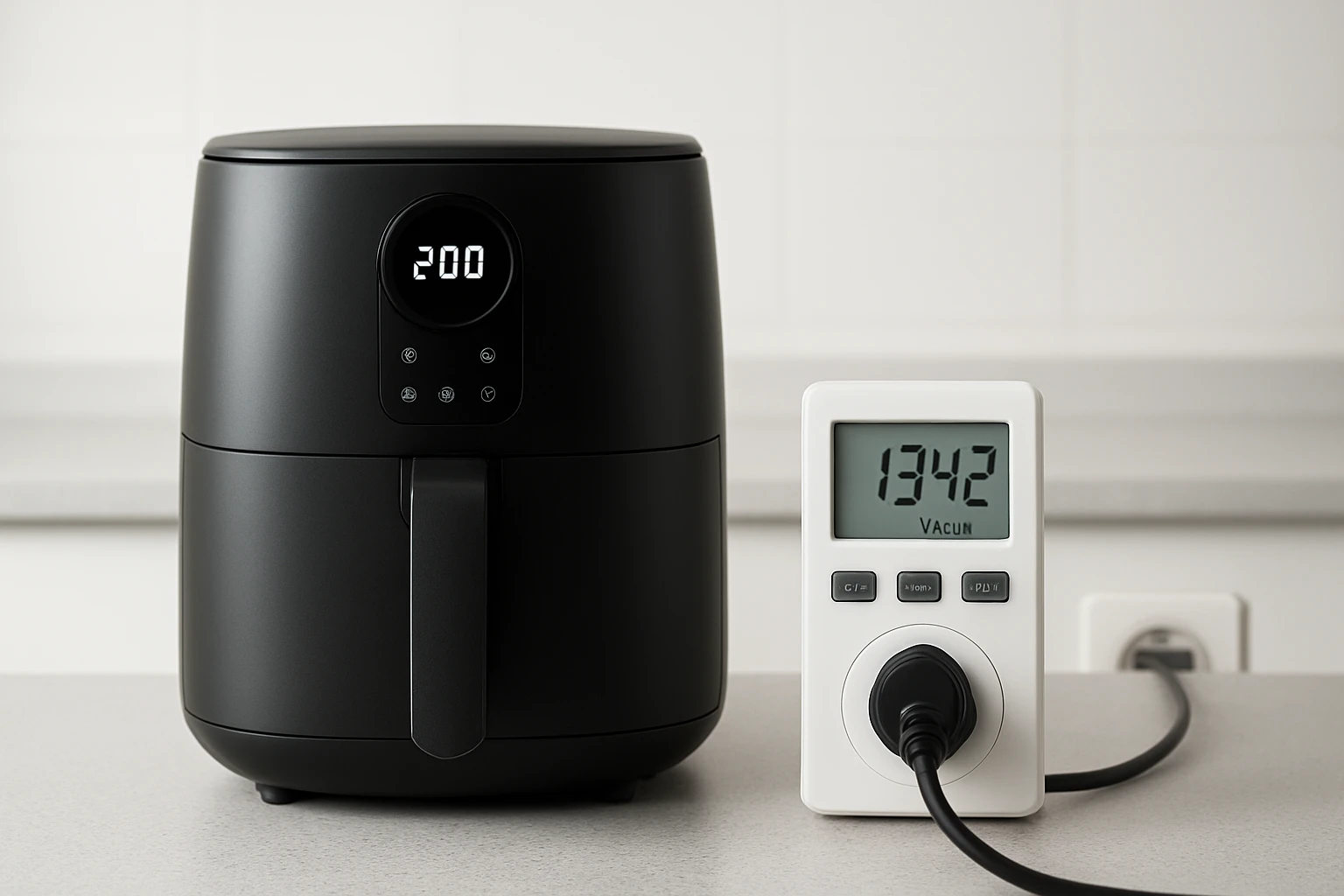
Although the label provides a maximum rating, real‑world usage often varies depending on the cooking mode and temperature. Using a plug‑in power meter, connect the air fryer and record the wattage displayed while operating at typical settings. For example, a test on the Bella Slim at 200 °C may show an average draw of 1,350 W, whereas the Chefman oven set to the “Bake” preset at 180 °C may average 1,650 W. Document these values in a table for reference.
Measuring actual consumption is useful because it accounts for the efficiency of the heating element, the duty cycle of the fan, and any standby power. The Bella’s EverGood™ Ceramic Nonstick Coating reduces the need for prolonged heating, potentially lowering average wattage, while the Chefman’s rapid‑air convection system may require short bursts of higher power to maintain temperature uniformity.
Step 3: Convert Watts to Kilowatt‑Hours
Energy consumption is expressed in kilowatt‑hours (kWh), which represents the amount of energy used when a device operates at one kilowatt for one hour. The conversion formula is:
kWh = (Watts × Hours) ÷ 1,000
Assume a cooking session of 30 minutes (0.5 hours) with the Bella Slim drawing 1,350 W. The calculation is (1,350 W × 0.5 h) ÷ 1,000 = 0.675 kWh. For the Chefman oven operating for 45 minutes (0.75 h) at 1,650 W, the energy use equals (1,650 W × 0.75 h) ÷ 1,000 = 1.2375 kWh. These figures illustrate that larger capacity appliances consume more energy for longer cooking cycles.
Understanding kWh is essential when selecting a battery because most portable power stations are rated in watt‑hours (Wh). Converting kWh to Wh simply involves multiplying by 1,000 (e.g., 0.675 kWh = 675 Wh). This step bridges the gap between appliance demand and battery capacity.
Step 4: Determine Required Battery Capacity
Battery capacity is commonly expressed in amp‑hours (Ah) at a given voltage. To translate watt‑hours to amp‑hours, use the relationship:
Ah = Wh ÷ Voltage
If a 12‑V lithium power station is selected, the Bella Slim's 675 Wh requirement translates to 675 Wh ÷ 12 V = 56.25 Ah. Adding a safety margin of 20 % to accommodate inefficiencies and temperature effects results in a recommended battery of approximately 68 Ah. For the Chefman oven, 1,237.5 Wh ÷ 12 V = 103.13 Ah, and with a 20 % buffer the ideal capacity rises to about 124 Ah.
Choosing a battery with a higher voltage, such as 24 V, reduces the required amp‑hour rating proportionally. For instance, the same 1,237.5 Wh at 24 V would need only 51.6 Ah. This principle helps the reader evaluate whether a compact 12‑V power bank or a larger 24‑V station better suits the cooking scenario.
Step 5: Validate Run‑Time and Safety Limits
After selecting a battery, verify that the inverter (if required) can supply the peak wattage of the air fryer. The Bella Slim’s peak of 1,350 W demands an inverter rated for at least 1,500 W to provide a margin. The Chefman’s 1,650 W peak similarly requires a 2,000 W inverter. Ensure that the battery's continuous discharge rating exceeds the calculated amp draw. For the Bella example, 1,350 W ÷ 12 V = 112.5 A; a battery capable of 150 A continuous discharge would be appropriate.
Finally, confirm that ventilation requirements are met. Both air fryers generate hot exhaust air; operating them in an enclosed enclosure without adequate airflow can trigger thermal shutdowns. Position the battery and inverter in a well‑ventilated area and keep the air fryer at least two inches from walls, as recommended by the Chefman user manual.
Tips & Pro Tips
- Record multiple measurements at different temperature settings to build a comprehensive energy profile.
- Use a battery management system (BMS) that provides real‑time voltage and current readouts; this aids in preventing over‑discharge.
- When cooking outdoors, consider solar panels to recharge the battery between batches; a 200‑W panel can replenish 1 kWh in five hours of strong sunlight.
- For extended cooking sessions, pre‑heat the air fryer while it is still connected to mains power, then switch to battery for the main cooking phase to reduce overall battery drain.
- Always follow the manufacturer's safety warnings regarding cord length and heat exposure to avoid fire hazards.
Troubleshooting
Problem: Battery depletes faster than calculated.
Solution: Verify that the inverter efficiency is accounted for; most inverters operate at 85‑90 % efficiency, which adds an extra 10‑15 % energy loss. Re‑calculate using an adjusted Wh value (e.g., 675 Wh ÷ 0.90 = 750 Wh).
Problem: Air fryer shuts down during operation.
Solution: Check that the battery is not exceeding its maximum discharge current. If the current draw approaches the battery's limit, either select a higher‑capacity battery or reduce the cooking temperature to lower power consumption.
Conclusion
By following the steps outlined above, one can accurately calculate the power consumption of an air fryer, convert that consumption into kilowatt‑hours, and size a portable battery to meet the desired run‑time. The process empowers the reader to make informed decisions about off‑grid cooking, emergency food preparation, and outdoor entertaining. With careful measurement, appropriate safety margins, and the right equipment, portable air frying becomes a reliable and convenient culinary option.
Products Mentioned in This Guide
Frequently Asked Questions
How do I calculate the wattage a typical air fryer uses?
Check the appliance label or manual for the rated wattage, or measure it with a power meter while the fryer is running.
What is the formula to convert air fryer wattage to kilowatt‑hours for battery sizing?
kWh = (watts × hours of use) ÷ 1,000; multiply the fryer’s wattage by expected run time and divide by 1,000.
How can I estimate how long a portable battery will run an air fryer?
Divide the battery’s total watt‑hours (voltage × amp‑hours) by the fryer’s wattage to get approximate run‑time in hours.
Do I need a pure‑sine wave inverter for an air fryer on a battery pack?
Most air fryers work with a standard modified‑sine inverter, but a pure‑sine inverter provides cleaner power and reduces the risk of error codes.
What safety precautions should I take when connecting an air fryer to a battery power station?
Use an inverter rated higher than the fryer’s wattage, ensure proper ventilation, and never exceed the battery’s maximum discharge rate.